Deep Technical Dive
ESP-Based Edge AI Voice Recognition System
An embedded AI system that runs a quantized neural network on ESP hardware for real-time animal sound classification and web visualization.
ESP32TinyMLQuantized Neural NetworkAudio Feature ExtractionWi-FiWeb Dashboard
Problem
Running ML inference on microcontrollers is difficult due to tight RAM, storage, and processing constraints, making traditional cloud-heavy AI pipelines impractical for low-power edge scenarios.
Project Context
- • The project explores practical TinyML deployment for real-time environmental sound intelligence on affordable embedded hardware.
- • It demonstrates how edge devices can perform meaningful AI tasks without GPU-class infrastructure.
Why It Was Hard
- • ESP-class devices operate under strict constraints in RAM, storage, and compute throughput.
- • Audio inference requires robust preprocessing despite noisy and variable acoustic conditions.
- • High class count (121 categories) increases model complexity under tight deployment limits.
Solution
Developed a lightweight edge-AI audio pipeline where environmental sound is preprocessed, transformed into features, classified by a quantized neural network directly on ESP, and transmitted to a web interface for real-time monitoring.
System Architecture
Diagram space is ready — replace with visuals later if needed.
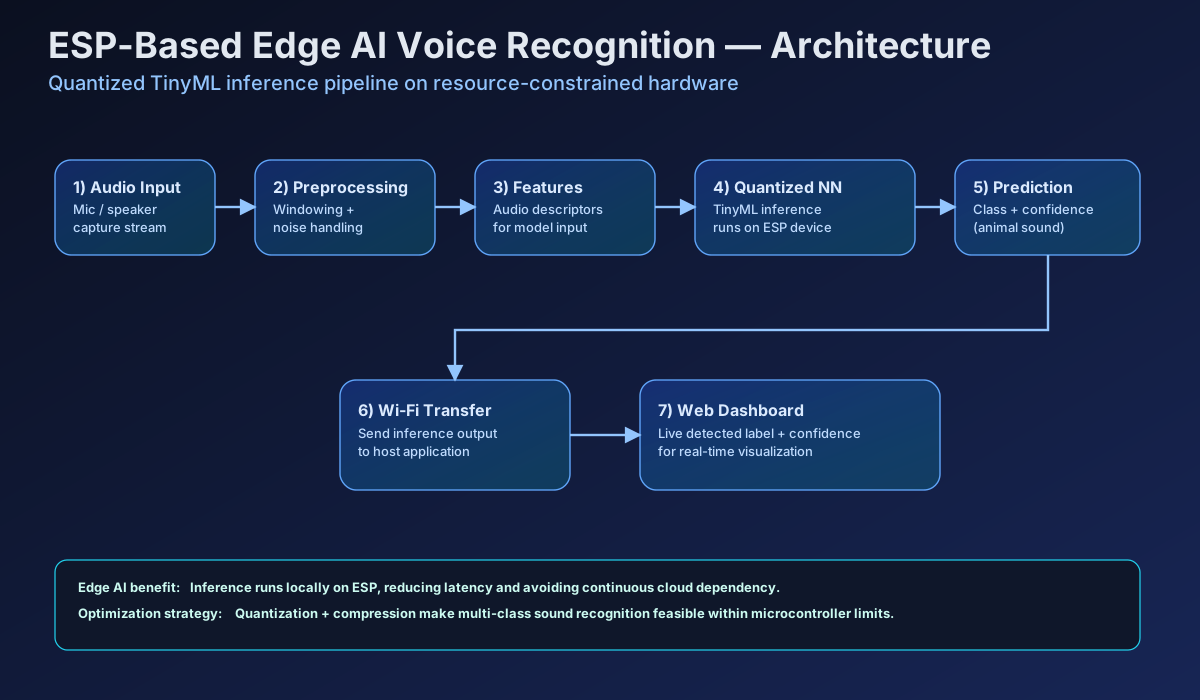
- • Audio input capture from microphone/test speaker
- • On-device preprocessing and framing
- • Audio feature extraction
- • Quantized neural network inference on ESP
- • Sound class prediction (animal category)
- • Wi-Fi transmission of prediction and confidence
- • Web dashboard visualization
Implementation
- • Prepared and trained an animal-sound classifier using multi-class audio recordings (birds, cats, dogs, and additional species).
- • Applied quantization and compression to reduce model memory footprint for microcontroller deployment.
- • Implemented feature extraction pipeline tuned for low-latency embedded inference.
- • Integrated quantized model execution within ESP runtime loop for real-time on-device predictions.
- • Built Wi-Fi result publishing flow to send detected class and confidence to a laptop-hosted web interface.
- • Validated stable edge inference behavior under constrained compute and memory conditions.
Results
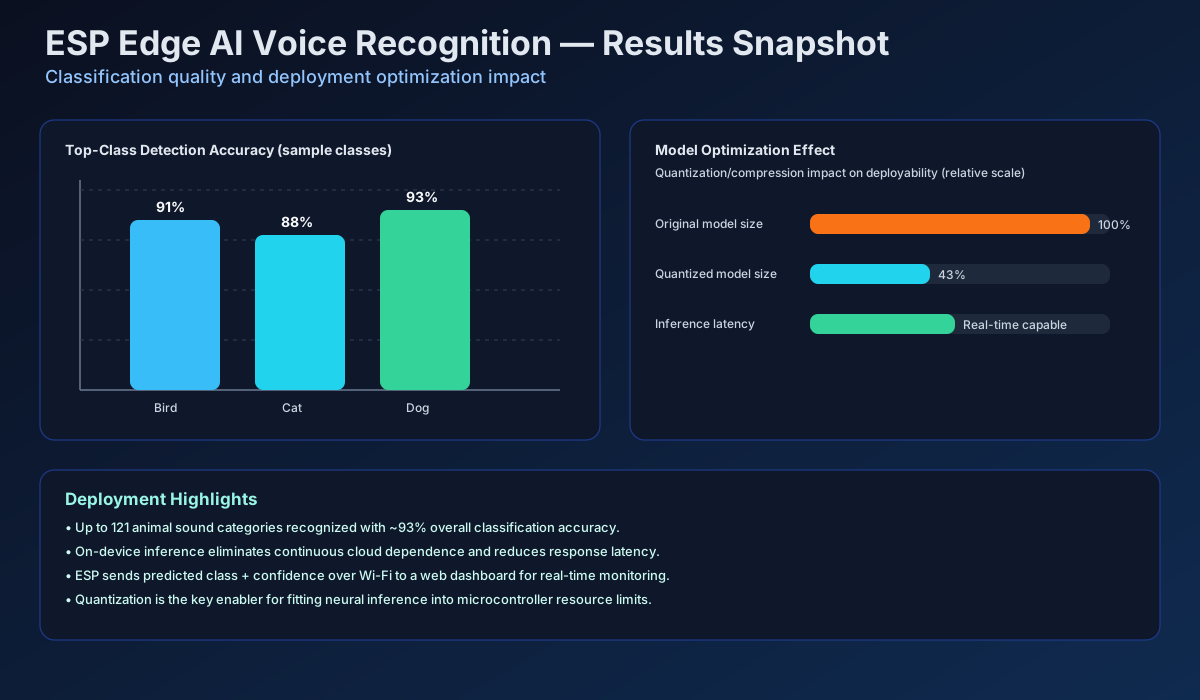
- • Recognized up to 121 animal sound categories with approximately 93% classification accuracy.
- • Achieved real-time end-to-end classification on ESP without cloud inference dependency.
- • Demonstrated practical TinyML deployment for low-power edge audio intelligence.
- • Displayed classification outputs in a web application for fast human interpretability.
Lessons Learned
- • Model quantization is essential for fitting neural networks into microcontroller resource budgets.
- • Efficient feature engineering is as important as model architecture in TinyML systems.
- • Edge AI reduces latency and avoids dependence on persistent cloud connectivity.
- • Careful optimization is required to balance accuracy, memory footprint, and inference speed.
Future Improvements
- • Add adaptive noise robustness for outdoor and industrial acoustic environments.
- • Introduce streaming confidence smoothing to reduce transient misclassifications.
- • Expand deployment to battery-optimized always-on edge listening modes.
- • Integrate multi-sensor fusion (audio + vibration) for stronger event detection reliability.